Pottery Wheels: A Complete Buying Guide
The short answer
Choose a pottery wheel by centering capacity and how smoothly it holds speed, not by wheel-head size. Beginners can learn on a budget wheel such as a VEVOR.
If you want a wheel to keep for years, the Speedball Clay Boss is the best-value full-size wheel sold on Amazon, with a half-horsepower motor and a 100 lb centering capacity.
Shimpo and Brent wheels are the studio standards and are sold by ceramic suppliers.
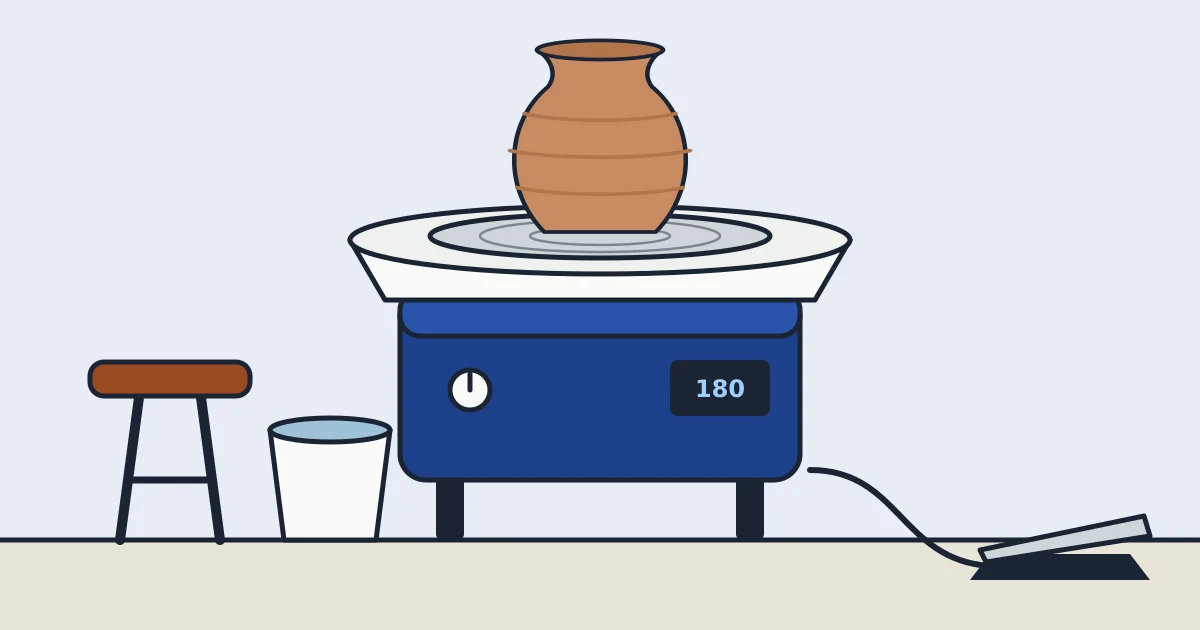
A pottery wheel, or potter’s wheel, is a motor, a spinning wheel head and a way to control the speed.
What separates a 150 dollar electric pottery wheel from a 1,500 dollar one is how well it keeps turning when you lean on the clay, how finely you can control it, and how long it lasts.
This guide explains what to compare, which pottery wheels for sale online fit which potter, and what owners say about them.
The four things to compare
1. Motor power and centering capacity
Centering is the hardest thing a wheel does. You press a lump of clay toward the middle while it spins, and a weak motor slows down.
Makers quote this as centering capacity in pounds.
- Under 20 lb: hobby wheels. Fine for learning and small pots.
- 25 lb: light studio and tabletop wheels.
- 100 lb and up: full studio wheels. More than most potters will ever use, which is the point: they never slow.
2. Wheel-head size
Most wheel heads are 11 to 14 inches. A bigger head gives room for wide plates and for bats, the removable discs you throw on.
Check that the head has bat pins on the standard 10 inch spacing.
3. Speed control
A good foot pedal lets you change speed smoothly and holds wherever you leave it. Some compact wheels use a hand lever instead.
Look for a reversing switch if you throw left-handed.
4. Size, weight and noise
Studio wheels weigh 50 to 130 lb and stay where you put them. Tabletop wheels can be put away after a session.
For a spare room or apartment, check the noise figure.
Wheels by level
| Product | Motor | Wheel head | Centering capacity | Best for | Link |
|---|---|---|---|---|---|
| VEVOR 11-Inch Pottery Wheel, 450W with LCD Touch Screen | 450 W | 11 in | 17.6 lb rated load | Trying pottery at home | View |
| Speedball Artista Tabletop Potter's Wheel | 1/3 HP | 11 in | 25 lb | Small spaces and classrooms | View |
| Speedball Clay Boss Pottery Wheel | 1/2 HP | 14 in | 100 lb | A first serious wheel | View |
Budget: a pottery wheel for beginners

VEVOR 11-Inch Pottery Wheel, 450W with LCD Touch Screen
- 450W motor and 11 inch wheel head
- Foot pedal and hand control, 60 to 300 RPM
- Forward and reverse
What owners say
Praised for: works well for the price.
Common complaints: wobbling wheel heads on some units; build quality varies.
Check price on Amazon$118.90
Price as of Nov 17, 2026, 3:20 PM UTC. Details
Product prices and availability are accurate as of the date/time indicated and are subject to change. Any price and availability information displayed on Amazon at the time of purchase will apply to the purchase of this product.A budget wheel is a low-risk way to find out whether you enjoy throwing. It will slow under heavy pressure and the pedal is less refined.
Our VEVOR pottery wheel review compares every model.
Portable: tabletop studio wheel

Speedball Artista Tabletop Potter's Wheel
- 1/3 HP motor, 25 lb centering capacity
- 11 inch wheel head, 0 to 220 RPM with a hand control
- Two-part splash pan, light enough to store
What owners say
Praised for: well made; portable; easy to clean.
Common complaints: a few units arrive not working.
Check price on Amazon$629.00
Price as of Nov 17, 2026, 3:20 PM UTC. Details
Product prices and availability are accurate as of the date/time indicated and are subject to change. Any price and availability information displayed on Amazon at the time of purchase will apply to the purchase of this product.The Speedball Artista is a real studio wheel in a tabletop body. It suits potters without a permanent space, and teachers.
Speed is set by hand lever, with a foot pedal and legs sold separately.
Buy it if you need to put the wheel away after each session or teach in different rooms. Skip it if you want a foot pedal as standard.
Step-up: a wheel to keep

Speedball Clay Boss Pottery Wheel
- 1/2 HP motor with 100 lb centering capacity
- 14 inch wheel head and a foot pedal, 0 to 240 RPM
- Load-sensing control holds speed under pressure
- Reversing plug, two-part splash pan, 10 year warranty
What owners say
Praised for: very quiet; strong and smooth; excellent value.
Check price on Amazon$1,149.00
Price as of Nov 17, 2026, 3:20 PM UTC. Details
Product prices and availability are accurate as of the date/time indicated and are subject to change. Any price and availability information displayed on Amazon at the time of purchase will apply to the purchase of this product.The Speedball Clay Boss is the wheel many home potters settle on. It has the power of far more expensive wheels and a long warranty.
Owner reviews are consistently positive, with quiet running and value mentioned most.
Buy it if you have a permanent spot and want a wheel you will not outgrow. Skip it if you are not yet sure you will stick with pottery.
Studio standards: Shimpo and Brent
Shimpo’s VL-Whisper is known for a near-silent direct-drive motor and a 100 lb capacity, and the VL-Lite is its lighter 25 lb model.
Brent wheels are the heavy-duty choice in schools and production studios. Both brands are sold mainly through ceramic suppliers.
We will compare them in Shimpo vs Brent.
Which wheel should you buy?
- Not sure pottery is for you: a budget wheel.
- Committed hobbyist with a fixed space: Speedball Clay Boss, or a Shimpo VL-Lite from a ceramic supplier.
- No permanent space: a tabletop wheel such as the Artista.
- Throwing large pieces or selling work: a 100 lb class wheel from Shimpo, Brent or Speedball.
How to set up a pottery wheel at home
- Pick a floor you can mop. Concrete, vinyl or tile. Put a mat down on anything else.
- Plan for water. Keep a bucket for throwing water and a second for rinsing tools. Clay must not go down the drain.
- Set the height. Sit with hips level with or slightly above the wheel head.
- Light the work. A lamp to one side shows the profile of the pot.
- Leave drying space. A shelf out of drafts and sun for finished pots.
Buying details
- New or used: studio wheels last decades, so a used Shimpo, Brent or Speedball is often a good buy. Check that the wheel head runs true and the pedal is smooth.
- Delivery: full-size wheels weigh 50 to 130 lb. Check shipping costs and whether you can move it into place.
- Warranty: studio brands offer multi-year warranties. Budget wheels usually carry much shorter cover.
What else you need
- A stool at a height that keeps your hips level with or above the wheel head.
- Bats if your wheel has bat pins.
- Basic tools: sponge, needle tool, wire cutter, wooden rib, trimming tools.
- Clay suited to throwing. A smooth mid-fire stoneware is the usual place to start.
- Access to a kiln. See our pottery kiln guide.
All pottery wheel guides
- VEVOR Pottery Wheel ReviewOur VEVOR pottery wheel review compares the 14 inch, 11 inch, tabletop and mini models on motor power, clay capacity and controls, with honest limits.
Frequently asked questions
What is the best pottery wheel for beginners?
A beginner needs a wheel that runs true, has a foot pedal and can center 3 to 5 lb of clay without stalling. A VEVOR 11 inch wheel does that for the lowest price.
The Speedball Clay Boss does it with far more power and a 10 year warranty.
How much does a pottery wheel cost?
Budget hobby wheels cost roughly 100 to 200 dollars. Entry-level studio wheels such as the Speedball Clay Boss and Shimpo VL-Lite are usually several hundred dollars to around 1,000.
Professional wheels from Shimpo and Brent run well above that.
What does centering capacity mean?
It is the maker's figure for the most clay the wheel can keep turning while you push it to center. It is a rough guide to torque.
Most potters throw less than 10 lb at a time, so a 25 lb wheel is enough for mugs and bowls, and 100 lb covers almost anything.
Do I need a kiln to use a pottery wheel?
To make finished ceramics, yes: pots must be fired. Many beginners throw at home and pay a local studio or community kiln to fire their work before buying a kiln.
Electric or kick wheel?
Electric for almost everyone. Kick wheels are quiet and need no power, but they are large, heavy and tiring to use for long sessions.
How much space does a pottery wheel need?
About 3 by 4 feet for the wheel and stool, plus a shelf for drying pots and a spot for buckets. A corner of a garage or spare room is enough.
Can I use a pottery wheel in an apartment?
Yes. Choose a quiet wheel, protect the floor, and plan how you will deal with clay water.
Many apartment potters use a tabletop wheel and take pots to a studio for firing.
How long does a pottery wheel last?
Studio wheels from Shimpo, Brent and Speedball commonly last 20 years or more. Budget hobby wheels are built for lighter use and a shorter life.